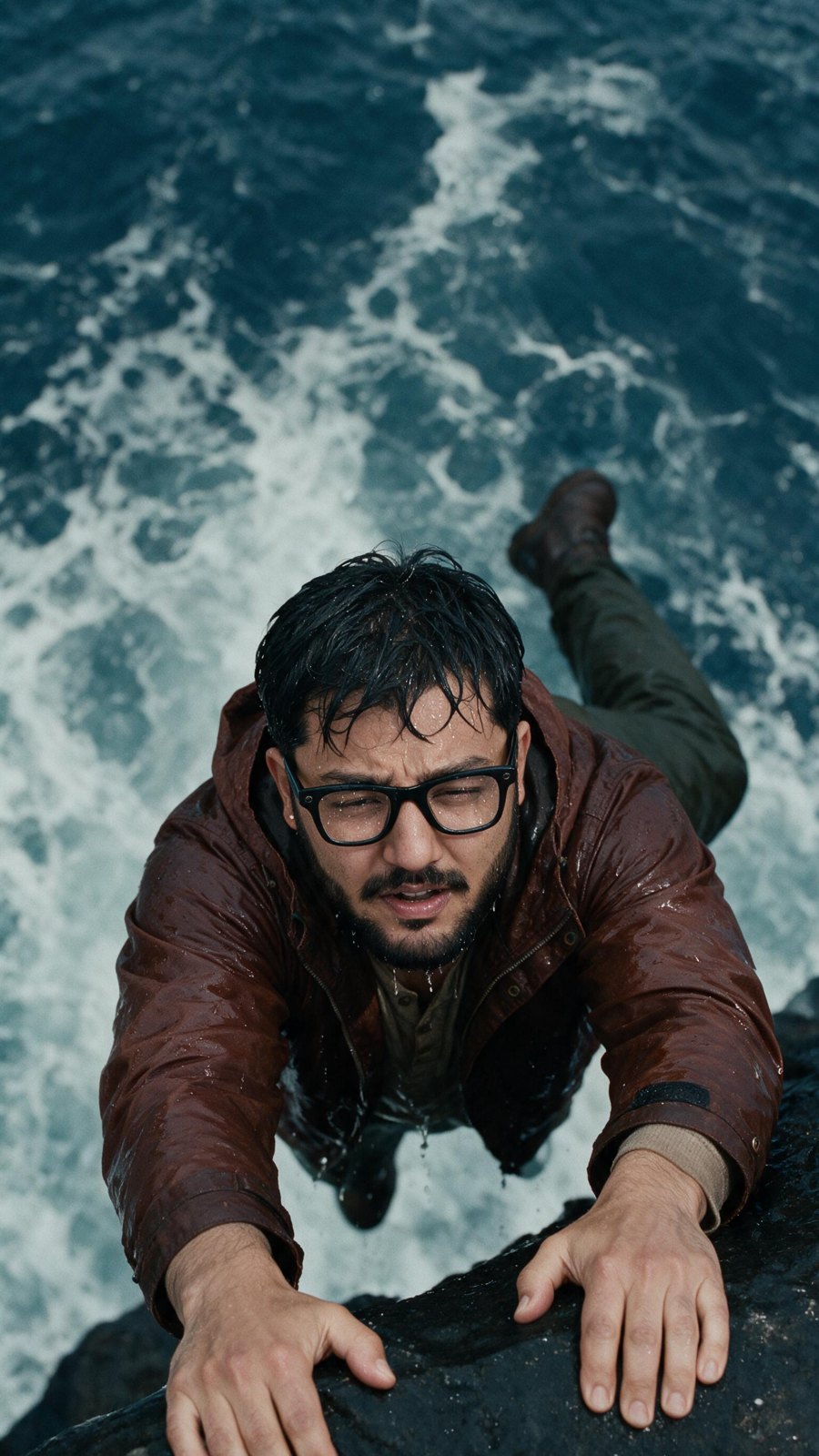
THE RIDE INTO WAR
00The idea
A man rides a white horse through a green valley, smiling, at full gallop. The camera pulls out to his side profile. And in that exact same gallop, without a single frame lost, he becomes a king riding into battle. Not a dissolve, not a wipe: a real edit, on the beat of the stride, so it reads as one motion across two lifetimes. Fifteen steps got this from idea to final cut. Every one is below, in the order it actually happened, including the ones that failed.
01The Tools


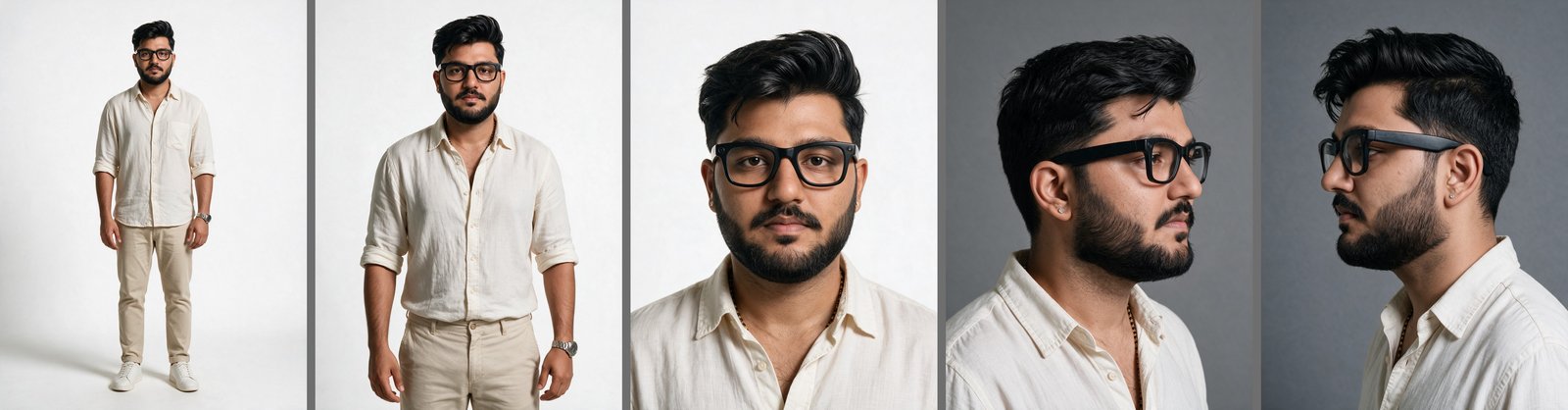
02Start from the character sheet
Every face in this film starts from the character sheet built on the previous page: one locked close-up master, one locked side profile. Nothing here works without that step done first. Two new identities had to be built on top of it for this film specifically: the present-day rider (already covered by the sheet) and the same man in Rajput war armour, centuries earlier.
03Remove the glasses, cleanly
The war-era identity could not carry modern acetate glasses, so the very first step was a single generation: the same face, same everything, glasses removed. This became the only face reference used for every armour generation after it. Reusing the everyday character sheet instead of this bare-face version was the mistake that caused the next problem.
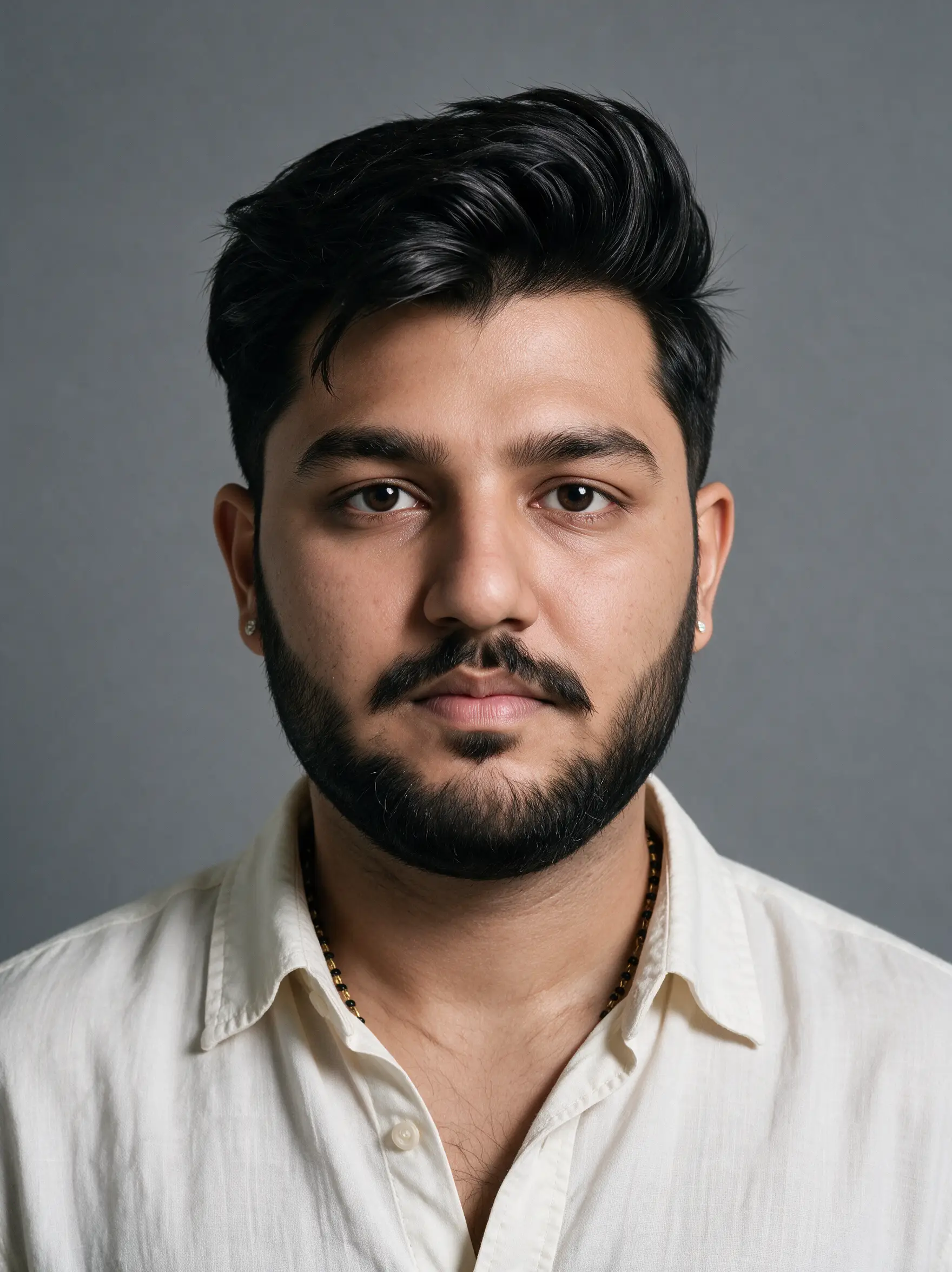
Tight chest-up studio portrait of the identical man from the reference image, exact same face, faithful likeness, no glasses, bare eyes clearly visible, neutral relaxed expression, mouth closed. Keep every other feature identical: same beard, same hair, same bone structure. Plain grey seamless studio background, soft diffused studio lighting, unretouched natural photograph, visible fine skin texture, sharp focus on the eyes, single subject only, no props, no text, no watermark.
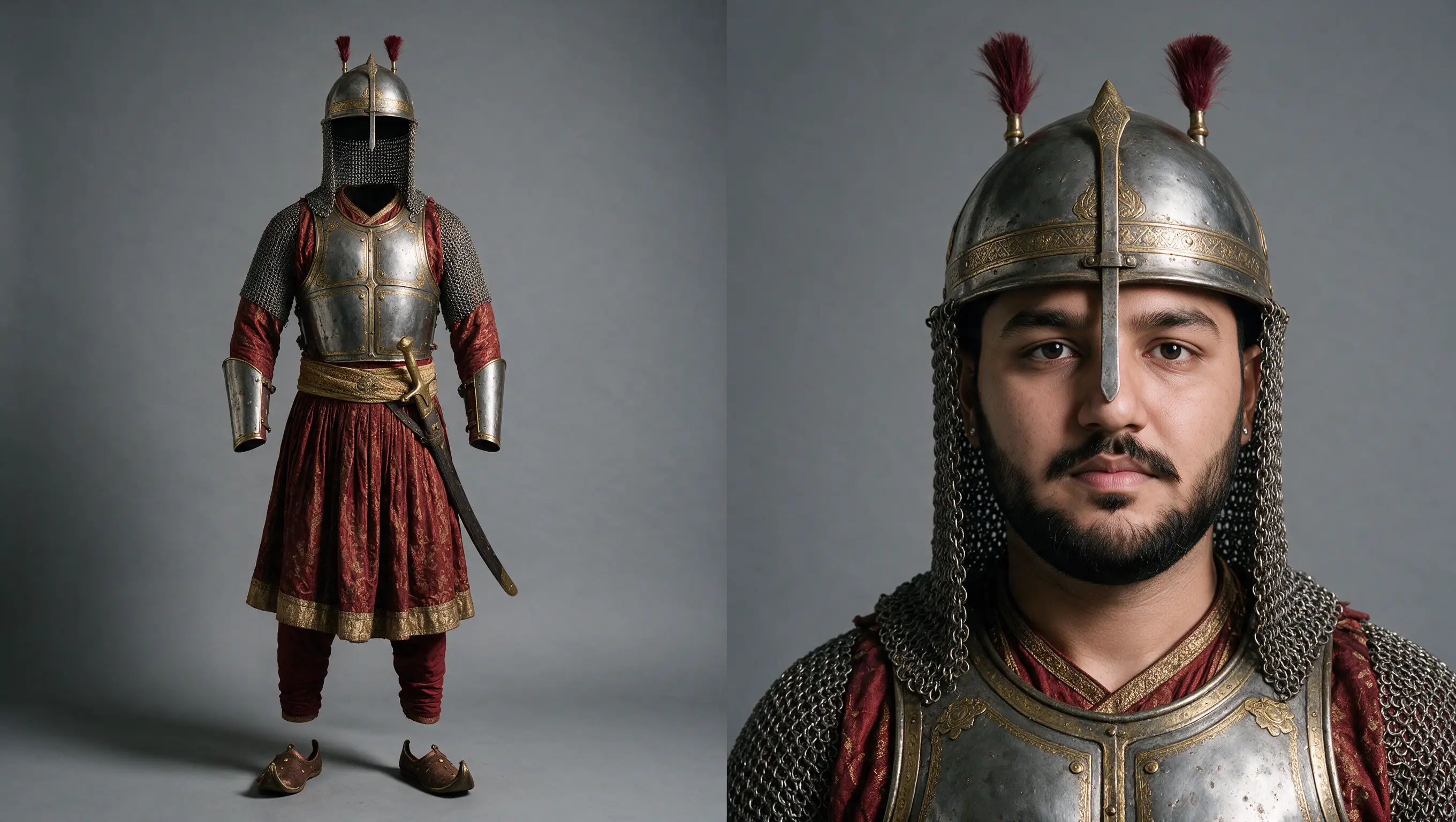
04Build the king's armour
With the bare-face master locked, the armour could be generated safely: a split sheet, the armour laid out ghost-mannequin style on the left, the helmeted face on the right. The first attempt at this step, before the glasses were removed in step 02, put the king in his everyday acetate glasses. Historically wrong, and it broke the illusion instantly. Referencing the bare-face master instead of the daily character sheet fixed it completely.
05Lock the king's three-quarter angle
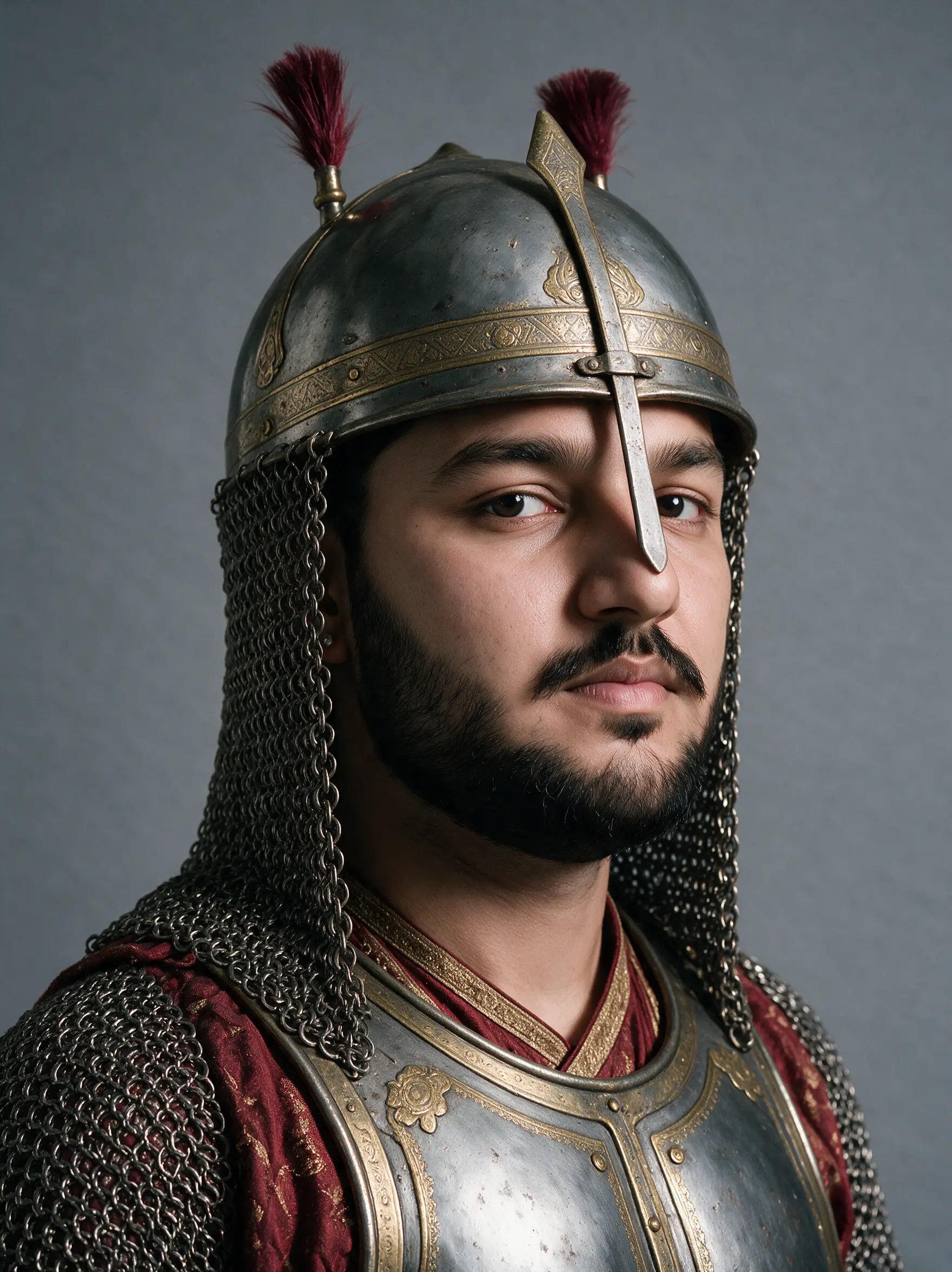
Video needs a face reference from the angle the camera will actually use. The first attempt at this three-quarter view came back on the wrong cheek, because a second, older reference image got passed in alongside the armour sheet and pulled the face toward it. The fix: reference only the locked armour sheet from step 03, nothing else, and state the direction in plain words.
06Build the horse
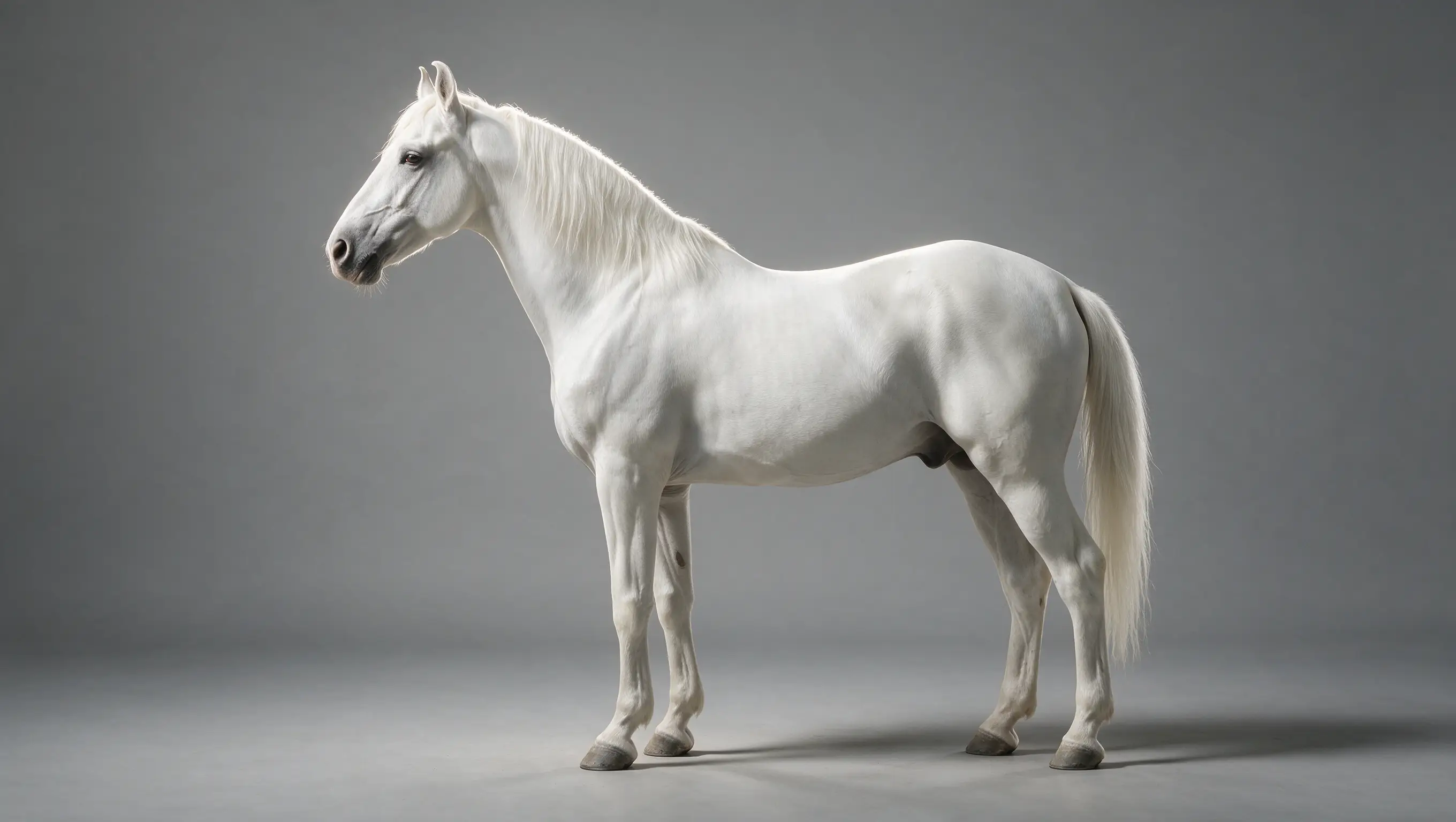
Same logic as a human character sheet, applied to an animal: one clean side-view master image with a plain grey background, used as the single source of truth for the horse from here on. The first attempt at this step came back with a black mane. "Pure white, including the mane and tail, nothing dark anywhere" had to be said twice before it held: video models default to realistic dark points on white horses unless you rule it out by name.
07Give the horse war tack
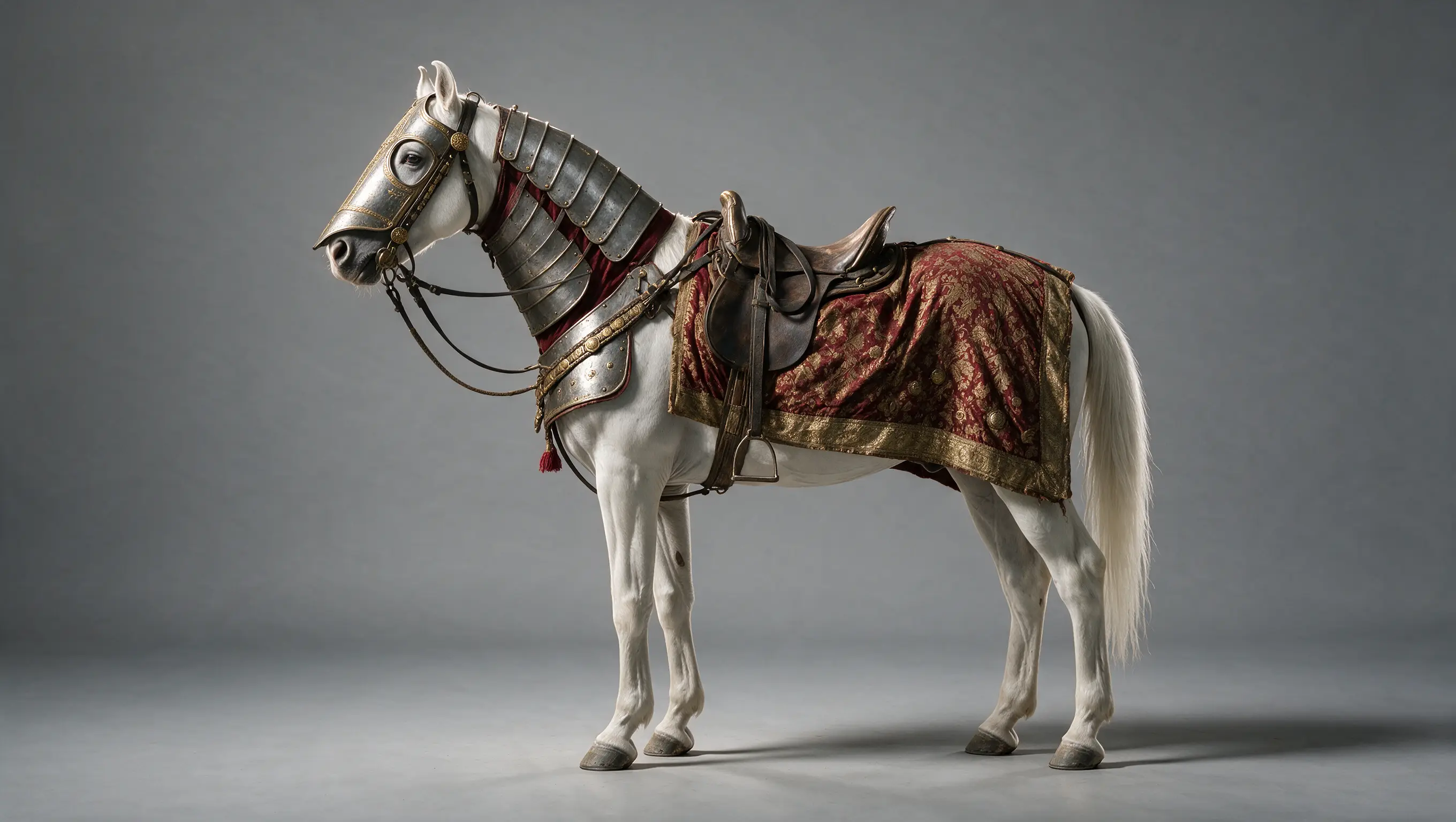
The battle half of the film needed the same horse, unmistakably the same animal, wearing war tack instead of the plain riding saddle. Generated as its own step, referencing only the horse master from step 05, so the coat, mane and markings stayed identical and only the tack changed.
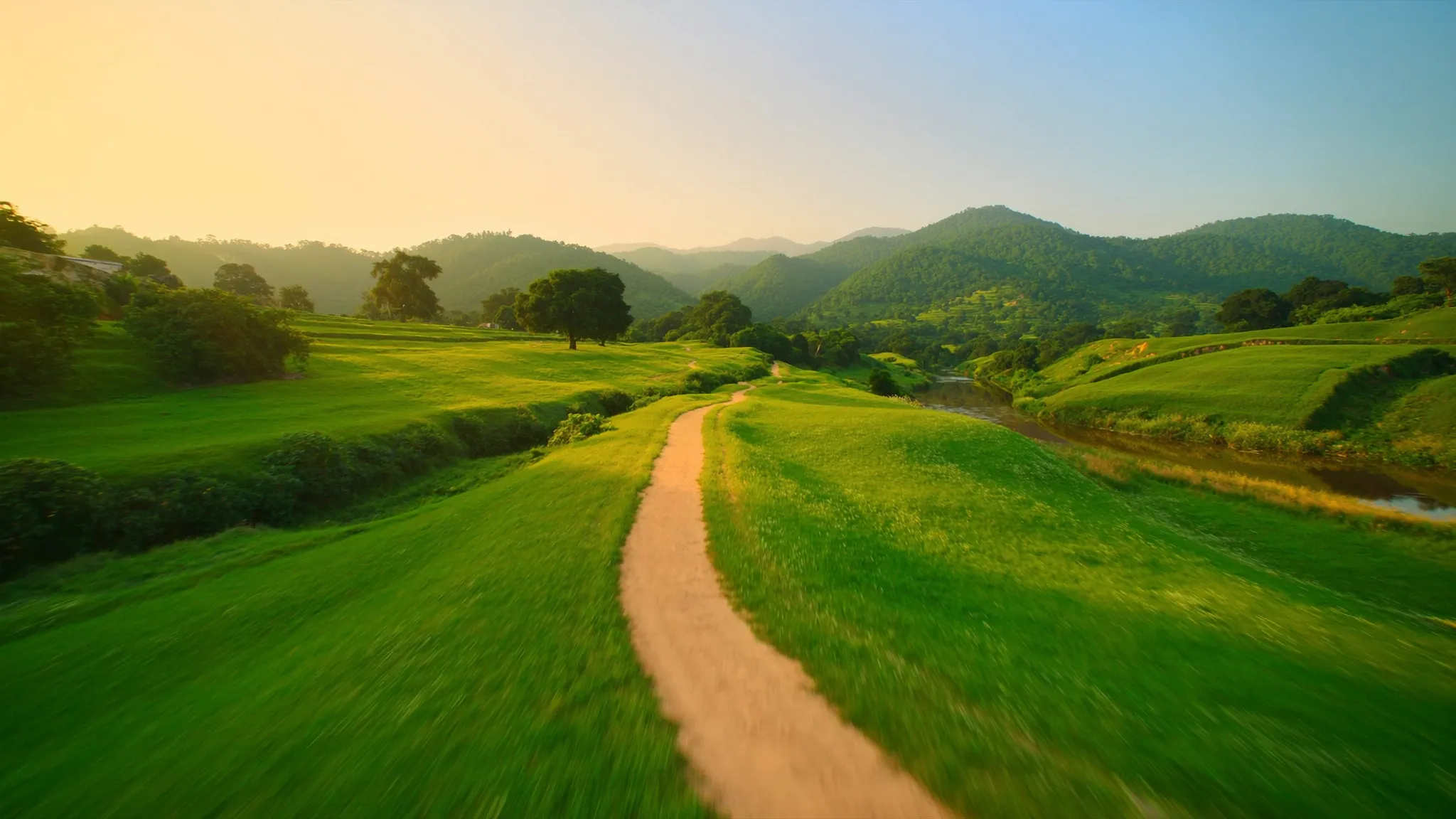
08Build the present-day location
The valley the ride happens in: green, golden hour, a sandy trail down the middle, a river along the right side. This composition matters beyond just looking good, because its exact geography has to be echoed in the war-era plate two steps from now.
09Build the war-era battlefield
The whole match cut depends on this step: the war-era ground had to feel like the SAME valley, centuries drier, not a different place. Same winding trail, same riverbed on the right, now cracked and dry, same hill silhouettes on the horizon. Generated completely empty, with no people or army in it. Armies get added later, inside the video prompt itself, where they can be positioned and directed precisely instead of being baked into a still.
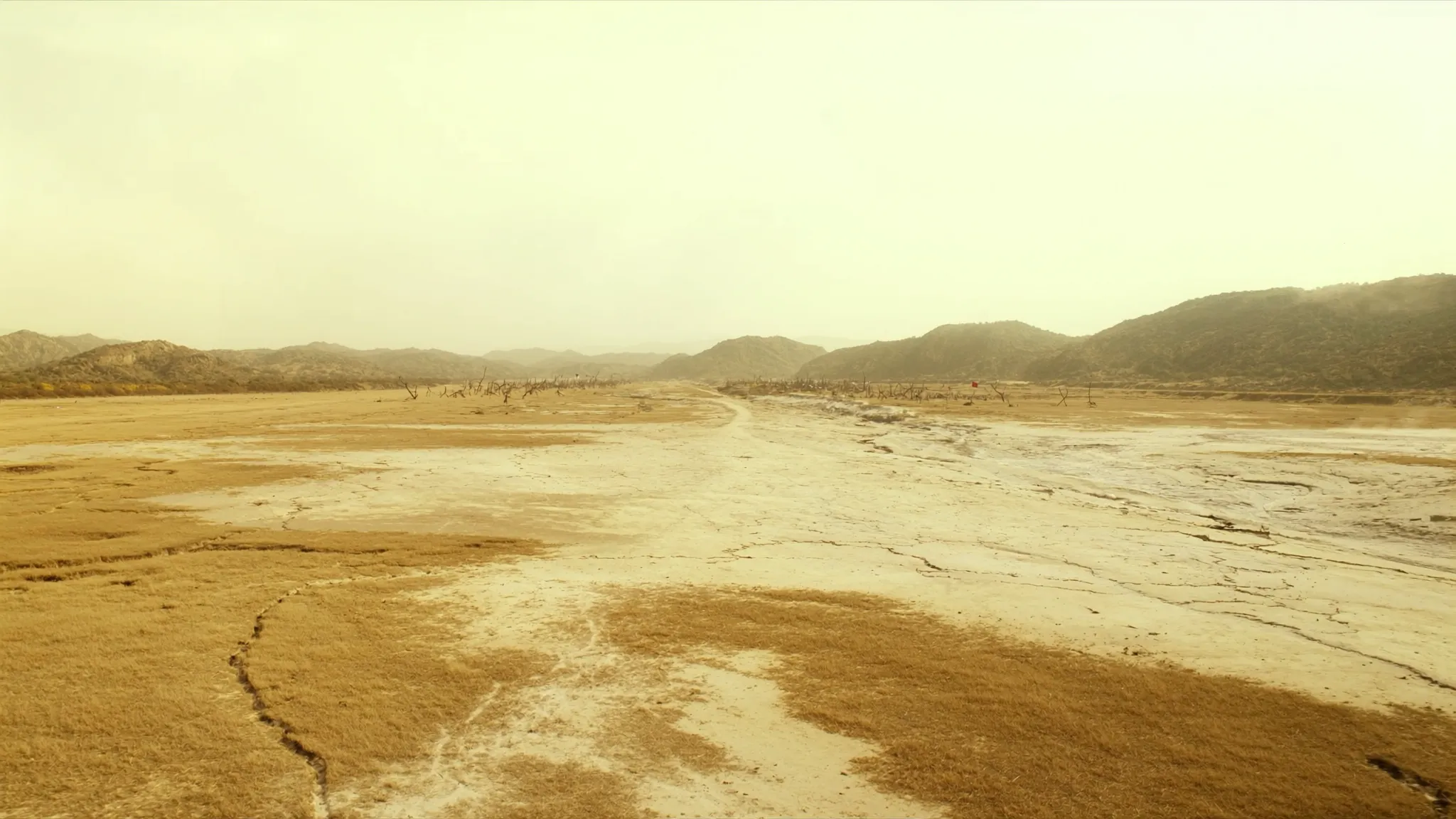
A vast empty battlefield in northern India, centuries ago, at the height of a brutal dry summer, completely EMPTY of any living thing. Wide flat open land of cracked sun-baked earth and trampled dust, a broad bare war-road running up the middle toward the horizon, patches of dead pale-straw grass and low ochre scrub. A nearly dry riverbed cuts along the RIGHT side, cracked mud with a thin trickle of water catching the light. Low bare brown-rock hills line the far horizon, hazy with distance. A few dead leafless trees stand far apart on the left. Harsh high dust-diffused sunlight, thin sand haze low over the ground, long dust-filtered shadows, pale hot sky. NO people, NO animals, NO tents, NO banners, NO weapons, NO structures, nothing man-made except the bare war-road. Seen from a low aerial angle, about 8 metres up, looking down the length of the road. Photorealistic, fine film grain, natural desert palette, no stylisation, no 3D-render look. 16:9.
That is every still image this film needed: two faces, two horses, two locations. Everything from here is video, built from those eight generations.
10Generate Clip One: the ride, alone
Early attempts tried to do the whole ride and the whole battle in one 18-second generation. It kept collapsing: motion looked like unintentional slow motion, the "transition" turned into a cheap dust-dissolve effect instead of a real cut, and random riders crossed the frame for no reason. The real fix was not a better single prompt, it was accepting that one generation cannot direct twelve things at once, and splitting the sequence into two clips joined by an edit, not an effect.
Clip one is just the ride: a flat-out gallop through the valley, camera arcing from a side profile to a three-quarter dolly-in. No forced pause at the end, because asking a video model to hold still fights against "keep moving at full speed" and looks unnatural. The clip just keeps galloping to its last frame, and the best frame gets picked afterward, in the next step.
An action-movie horse ride. A young man on a magnificent white stallion tears through a lush green valley at golden hour at FULL RACING GALLOP. He rides leaning forward into the speed with an easy, natural smile, not a posed grin. One continuous shot: side profile arcing to a three-quarter diagonal with a dolly-in. Camera stays locked to his good side the entire clip. His thick quiff keeps its volume and bounces with the stride, never plastered flat. 35mm chase rig, 180 degree shutter, heavy directional motion blur on the background while horse and rider stay sharp. The gallop never slows, all the way to the last frame, no forced pause or freeze. Golden hour lighting, natural documentary colour, silent, no music or voice. 16:9, 9 seconds, real time throughout.
11Pull the exact final frame
This is not an AI step, it is one ffmpeg command against the approved clip one, pulling the last real frame at full resolution. This still becomes the anchor for the entire second half of the film.
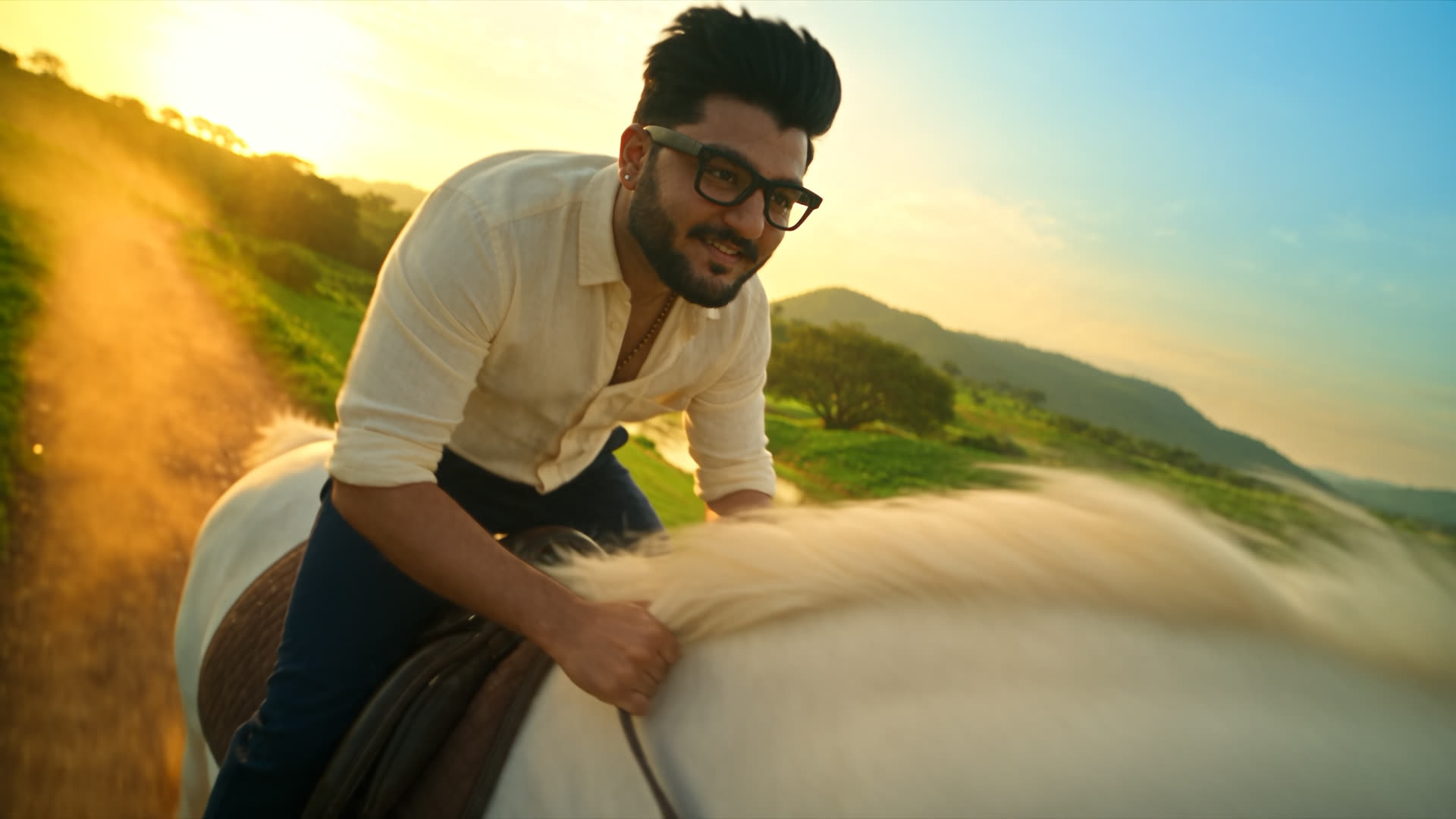
ffmpeg -sseof -0.05 -i clipA.mp4 -frames:v 1 -q:v 1 clipA_lastframe.png
12Turn that frame into war, first pass
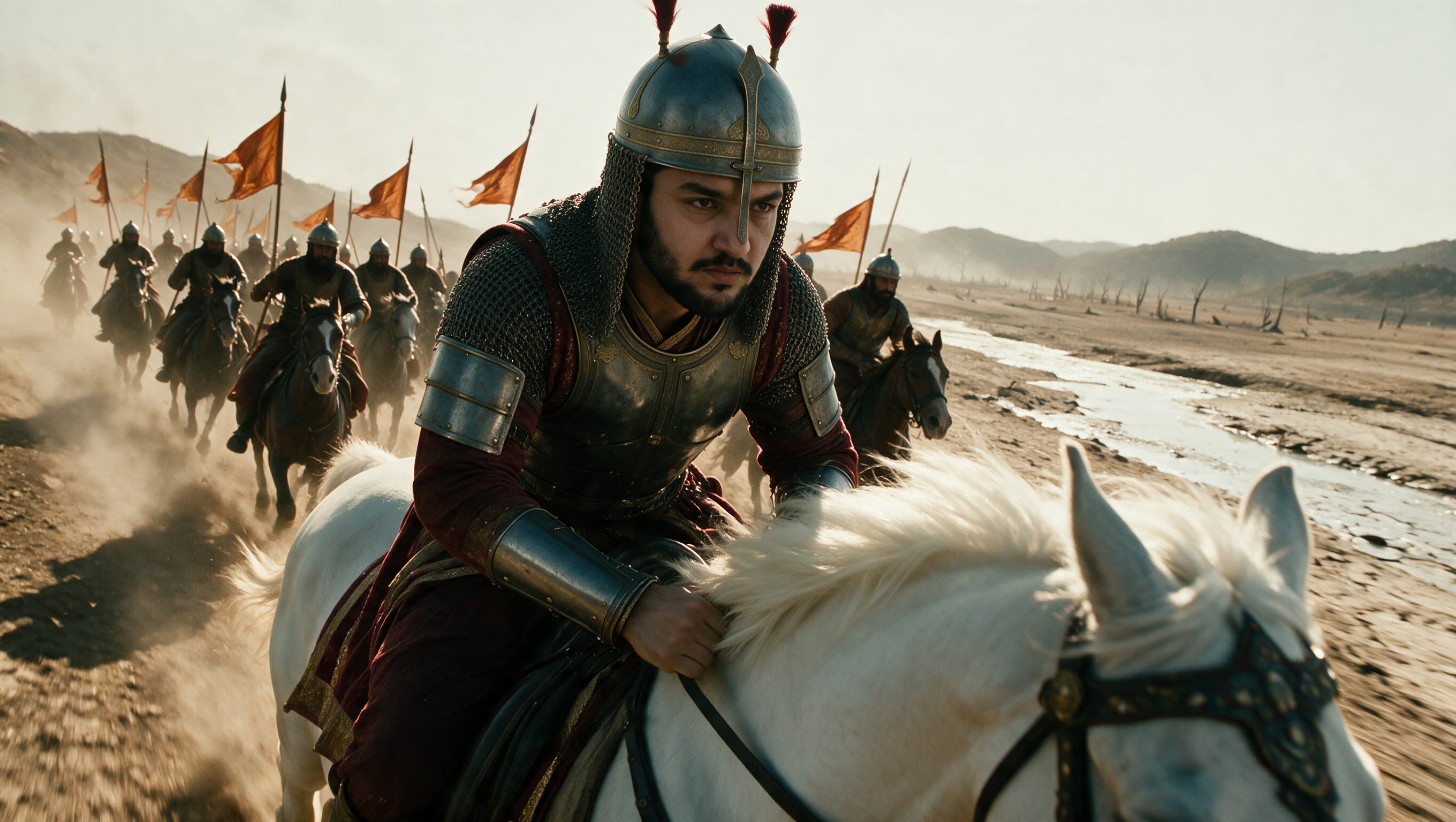
This is where the actual match cut gets built, before any video runs. The extracted still becomes a reference image, and a new still is generated from it: same pose, same camera angle, same horse mid-stride, only the era changes. The first pass got the pose right but left a stream of water in frame that did not belong on a dry battlefield, and had no army in it yet.
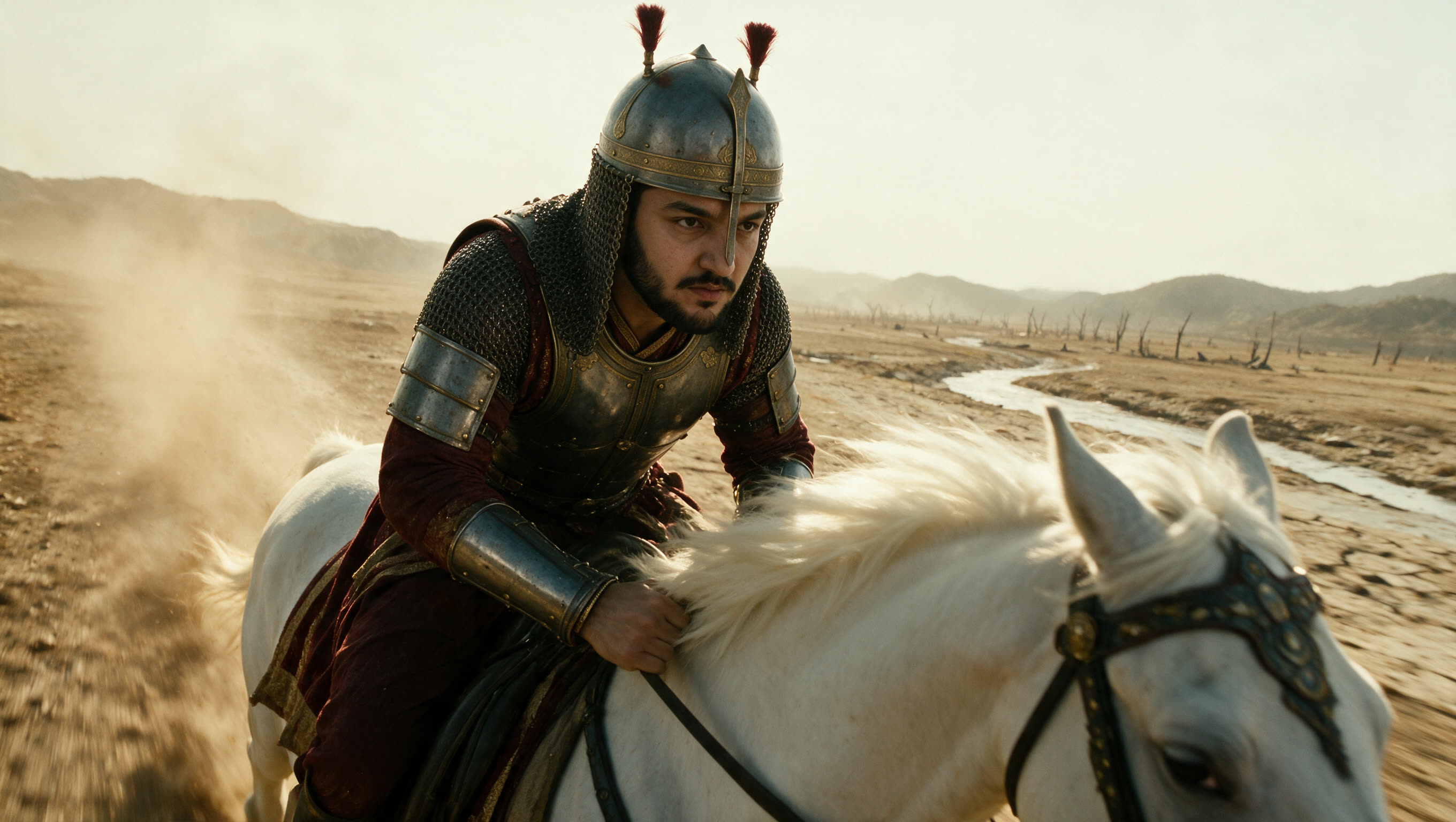
A precise match-cut twin of the extracted frame: recreate the EXACT same photograph, identical camera angle, identical framing, the rider in the IDENTICAL pose, the horse's head, neck and flying mane in the identical position mid-gallop, the same motion blur direction, the same dust streak, but transformed to another century, in war. Changes, and only these: the rider becomes the king in full armour, no glasses, same exact face. His expression turns hard and focused, no smile. The horse wears war tack, same white coat and mane. The world becomes the dry battlefield plate. No water anywhere in frame. Everything about the geometry, pose and motion of the source frame is preserved exactly; only era, wardrobe, world and expression change.
13Add the army, lock the keyframe
A second pass removed the water fully and added the cavalry, positioned deliberately behind him and to one side, never in front, under saffron banners, softened with motion blur so they read as background without pulling focus from him. This became the locked first frame of clip two.
14Generate Clip Two: the battle
This clip had to solve four problems the first attempts got wrong. First, the model treats "epic battle" as a cue for floaty slow motion unless given a real number, so the prompt states outright that a galloping horse takes about two and a half strides a second. Second, an explicit on-screen beheading tends to get filtered or comes back as confused fake-looking blood, so the kill is written as one stroke and one brief realistic mist at the point of impact, nothing more. Third, riders kept crossing in front of the hero for no reason, fixed with a hard direction lock: he moves one way, the enemy enters only from the opposite side, nobody crosses vertically. Fourth, because this model has no true "start frame" slot, the reference image has to be argued into place with a block that insists, in absolute terms, that frame one already matches it, already at full speed, nothing settling in.
A Rajput king charges across a dry battlefield on a white war stallion at a flat-out racing gallop, roughly two and a half strides a second, real time, no slow motion anywhere. Frame one IS the reference keyframe, already at full speed, nothing settling in. His cavalry charges close behind him under saffron banners. The camera sweeps from the opening frame to a head-on front view, then arcs around to a full 90 degree side profile, tracking level with him. He draws his sword and points it forward, a silent command, no dialogue. His cavalry surges. The enemy army, dark armour, dark horses, no banners, enters from the opposite side once the camera is in profile, closing head on so nobody crosses in front of him. One enemy rider meets him in the pass; one clean stroke; one brief realistic mist of blood at the point of impact and nothing more, no fountains, no gore. Shallow depth of field locks focus on the king alone: his face and armour stay tack sharp while his own cavalry, the enemy, and the wider battle all fall into soft, motion-blurred layers behind him. He never slows, never looks back, rides through the final frame. Silent, no music. 16:9, 12 seconds.
One more lesson from an earlier draft of this prompt: an early version referenced a real filmmaker by name to describe the intended visual scale, and the generation was rejected for it. Describing the style in plain words instead worked exactly as well and caused no issue.
15The cut itself
There is no transition effect anywhere in this film. The last frame of clip one and the first frame of clip two sit back to back on the timeline. Because clip two's first frame was purpose-built as a twin of clip one's last frame, the cut reads as one continuous motion across two centuries, on a straight hard edit.
ffmpeg -f concat -safe 0 -i filelist.txt -c copy ride_into_war.mp4
# filelist.txt:
# file 'clipA_ride.mp4'
# file 'clipB_battle.mp4'
16What not to do
- Do not ask one generation to direct more than three or four beats. Split into clips joined by a real edit instead.
- Do not let the model perform the transition. Build both end frames yourself and cut between them.
- Do not name a real director, filmmaker or public figure in a prompt. Describe the visual style in plain words, it works just as well and does not trip content filters.
- Do not describe motion with adjectives alone. "Epic" and "cinematic" drift toward slow motion. State a real number: strides per second, seconds per shot.
- Do not write an on-screen beheading or graphic gore. State one clean stroke and one brief realistic detail, nothing more, or the model either refuses or fakes it badly.
- Do not force a held pause at the end of a fast-motion clip. It fights the rest of the prompt and looks unnatural. Let it run to the end and pick the best frame after.
- Do not assume a video model remembers your last generation. It sees only this prompt and this reference image. Every instruction has to stand on its own.
Two clips, one cut, no plugin.
The hardest part was never the render. It was learning to stop asking one generation to do a director's whole job.